Supervised and Unsupervised Learning Explained
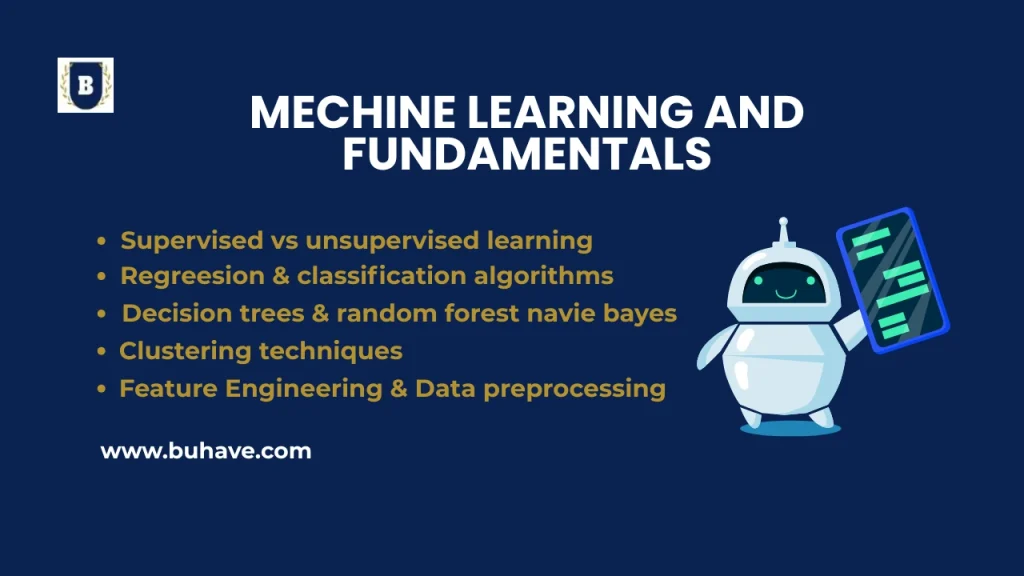
Machine Learning is a branch of Artificial Intelligence that enables systems to learn from data and make decisions without being explicitly programmed. It is broadly categorized into Supervised Learning and Unsupervised Learning, with each approach offering distinct applications and methods. Let’s explore them in detail.
1. Supervised Learning
In supervised learning, the algorithm is trained on a labeled dataset, meaning the input data already has corresponding output values. The goal is to learn a mapping function from inputs to outputs so the model can predict future outcomes accurately.
Types of Supervised Learning:
- Regression: Predicts continuous values. Example: Predicting house prices based on features like size, location, and age.
- Classification: Predicts discrete labels. Example: Email classification as spam or not spam.
For a deeper mathematical treatment of these methods, see Mathematics for AI.
For a deeper look into neural networks as an alternative approach, see Deep Learning and Neural Networks.
2. Unsupervised Learning
Unsupervised learning works with unlabeled data. The algorithm identifies patterns, groupings, or structures in the data without prior knowledge of output labels.
Types of Unsupervised Learning:
- Clustering: Grouping similar data points together based on their features.
- Dimensionality Reduction: Reducing the number of input features while preserving as much information as possible.
For NLP applications that leverage unsupervised techniques, see Natural Language Processing (NLP).
Popular Clustering Techniques
- K-Means Clustering: Divides data into k clusters by minimizing the distance between data points and their cluster center.
- Hierarchical Clustering: Builds a hierarchy of clusters either from bottom-up (agglomerative) or top-down (divisive).
- DBSCAN: Groups data points based on density and is useful for datasets with irregular shapes and noise.
For practical AI applications, see AI Applications and Advanced Topics.
3. Data Preprocessing
Before feeding data into a machine learning model, it’s essential to clean and prepare it. Data preprocessing improves model performance and ensures meaningful insights.
- Handling Missing Values: Fill in missing data using methods like mean imputation or remove rows with missing values.
- Encoding Categorical Variables: Convert non-numeric data into numerical format using techniques like one-hot encoding or label encoding.
- Feature Scaling: Normalize or standardize numerical features to bring them to a similar scale (e.g., MinMaxScaler, StandardScaler).
For a mathematical perspective on preprocessing steps and feature scaling, see Mathematics for AI.
4. Feature Engineering
Feature engineering is the process of selecting, modifying, or creating new features from raw data to improve model performance.
Common Feature Engineering Techniques:
- Feature Selection: Choosing the most relevant features to reduce noise and overfitting.
- Feature Creation: Deriving new features by combining existing ones. For example, creating a “BMI” feature from height and weight.
- Binning Converting continuous data into categorical bins (e.g., age groups).
- Interaction Features: Creating features based on the interaction between two or more variables.
For a mathematical perspective on feature engineering, see Mathematics for AI.
Conclusion
Understanding the difference between supervised and unsupervised learning is crucial for choosing the right approach based on your data and problem type. Supervised learning is ideal for prediction tasks where historical data is labeled, while unsupervised learning is used to discover hidden patterns or structures in data. With the right preprocessing and feature engineering, machine learning models can deliver highly accurate and insightful results.
For a broader view of AI foundations, see Introduction to Artificial Intelligence (AI).